Carbon Reduction Plan
Supplier name: Pertemps Network Group Limited
Publication date: 17th September 2025
1 COMMITMENT TO ACHIEVING NET ZERO
Pertemps Network Group Limited is committed to reducing our impact on the environment and protecting the planet and its resources and achieving Net Zero emissions by 2040.
2 BASELINE EMISSIONS FOOTPRINT
Baseline emissions are a record of the greenhouse gases that have been produced in the past and were produced prior to the introduction of any strategies to reduce emissions.
Baseline emissions are the reference point against which emissions reduction can be measured.
Baseline Year: 2025
Additional Details relating to the Baseline Emissions calculations.
The baseline defined relates to the Pertemps Network Group Limited and covers our operations in the UK. 2020 was our first year of reported emissions and was initially our baseline year, 2025 was our fifth year of reported emissions.
As part of our commitment to improving the accuracy and transparency of our emissions reporting, Pertemps has expanded the range of Scope 3 categories included in our carbon footprint. To reflect this more comprehensive approach, we have re-baselined our emissions to 2025 to ensure consistency and comparability in future reporting. This change aligns with government guidance under PPN 06/21 and supports our long-term carbon reduction strategy.
Baseline year emissions: 1 April 2024 – 31 March 2025 (2025)
EMISSIONS TOTAL (tCO2e)
Scope 1 376
Scope 2 261
Scope 3 1,395
(Included Sources)
Total Emissions 2,032
3 CURRENT EMISSIONS REPORTING
Reporting Year : 1 April 2024 - 31 March 2025 (2025)
EMISSIONS TOTAL (tCO2e)
Scope 1 376
Scope 2 261
Scope 3 1,395
(Included Sources )
Total Emissions 2,032
We have assessed the relevance and materiality of the 5 categories of Scope 3 emissions required for the Procurement Policy Note (PPN) 06/21. Based on this assessment, we have excluded the following categories from our Carbon Reduction Plan on the grounds that they are considered immaterial to our overall carbon footprint and reduction planning.
• Upstream transportation and distribution
• Downstream transportation and distribution
We are committed to continually reviewing this for our future reporting years and have included within our Planned Carbon Reduction Initiatives measures with our Scope 3 continual improvement review.
4 EMISSIONS REDUCTION TARGETS
During the reporting period, total GHG emissions increased by 171% compared to the previous year.
However, this increase is due to the inclusion of Scope 3 emissions for upstream emissions from purchased fuel and energy, employee commuting and waste, in this year’s report, which were not included previously due to data complexity.
These activities have contributed significantly to the overall increase and should be considered when interpreting the change in total emissions.
Due to this additional reporting, we have re-baselined our emissions to ensure consistency and comparability in future reporting. This change aligns with government guidance under PPN 06/21 and supports our long-term carbon reduction strategy.
In order to continue our progress to achieving Net Zero by 2040, we have updated our carbon reduction targets as below.
We project that carbon emissions will decrease over the next five years to 1354.5 tCO2e* by 2030. This is a reduction of 33%.
Progress against these targets will be seen in the graph below:
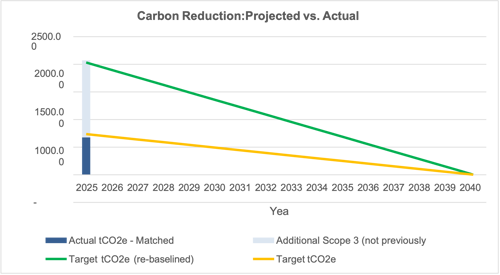
*tCO2e – tonnes of carbon dioxide equivalent emissions
5 CARBON REDUCTION PROJECTS
At Pertemps we are committed to reducing our impact on the environment and protecting the planet and its resources.
At the heart of our environmental commitment is our certified ISO 14001 Environmental Management System, which provides a structured and proactive framework for managing our environmental responsibilities. This framework supports continuous improvement, legal compliance, and sustainable development across our businesses.
Our energy and carbon reduction initiatives are driven by a structured, data-driven approach that aligns with our core values and long-term sustainability goals.
5.1 Completed and Ongoing Carbon Reduction Initiatives
The following environmental management measures and projects have been completed or implemented since the original 2020 baseline. Our carbon emission reduction since our original 2020 baseline year from these schemes, for like-for-like emissions equate to a reduction of 147 tCO2e, a 16% reduction against the 2020 baseline and the measures will remain in effect when performing client contracts during the current reporting year.
We conduct annual carbon emissions reporting to monitor our energy use and greenhouse gas emissions. This enables us to measure progress against our reduction targets, identify opportunities for improvement, and demonstrate our continued commitment to environmental sustainability. We have accelerated our carbon reduction targets, bringing forward our goal of achieving Carbon Neutrality for our Scope 1 and 2 emissions to 2030 and our Scope 3 emissions to 2035, five years earlier than previously planned, while maintaining our longer-term ambition to reach Net Zero by 2040. Transparent reporting supports regulatory compliance, strengthens accountability, drives meaningful change and supports our eligibility for public and private sector clients.
To improve our carbon emissions reporting and tracking detail, we utilise MIDAS (Mileage Input and Data Analysis System) fleet and mileage management software, developed internally, which provides precise data in recording CO₂ emissions per vehicle, employee and journey. This granular insight allows us to identify high-emission vehicles, inefficient journeys and to implement targeted reduction strategies to reduce our carbon emissions from business travel.
A major milestone in our journey has been the transition of our company fleet from fossil fuels to electric alternatives. Today, 85% of our fleet comprises hybrid or battery electric vehicles, significantly reducing our transport-related emissions. To support this shift, we have expanded our EV charging infrastructure across the Group, increasing the number of charging points to 26.
We also undertook a strategic review of our vehicle leasing arrangements to assess the viability of transitioning from three-year to two-year contracts. This approach would enable more frequent fleet renewal, accelerate the integration of the latest low-emission vehicle technologies and support our commitment to sustainability.
We have transitioned all offices under our operational control to 100% renewable electricity. We have achieved this by installing solar panels at our head office, enabling onsite generation of renewable energy to meet a portion of our electricity needs. For the remaining demand, andat locations where we can have operational control contracts, we source electricity through certified renewable tariffs. This change represents a significant milestone in our decarbonisation journey and reinforces our commitment to clean, sustainable energy across our operations, through self-generation and responsible procurement.
We’ve continued to reduce our environmental impact by increasing diverting our waste from landfill through improved reuse and recycling initiatives, supporting our commitment to responsible waste and resource management.
Our ongoing participation in the EcoVadis assessment provides independent validation of our wider sustainability (ESG) performance, including reporting on total energy use, greenhouse gas (GHG) emissions and carbon reduction initiatives. This enhances our transparency and delivers actionable insights that support continuous improvement.
The actions we have taken to date reflect our ongoing commitment to reducing our environmental impact and protecting the planet and its resources. These are regularly reviewed to assess their effectiveness and ensure we remain aligned with our goals.
5.2 Planned Carbon Reduction Initiatives
Pertemps are undertaking a Group-wide sustainability review to refine our Sustainability objectives including actions related to energy use and carbon emissions. This review will be supported by updated key performance indicators (KPIs) to ensure measurable progress and accountability.
To support this, we are advancing a programme of initiatives to further drive our commitment to energy efficiency and carbon reduction across our operations.
To build on our current progress, we are developing carbon and energy reduction strategies, identifying new opportunities to lower emissions and improve operational efficiency. A key part of this strategy includes the expansion of our Scope 3 greenhouse gas (GHG) emissions reporting, enabling us to better understand and reduce emissions across our value chain.
Employee commuting accounts for a large percentage of our total GHG emissions. We are exploring measures such as cycle to work schemes, car-sharing incentives, EV salary sacrifice schemes, and subsidised charging to support low-carbon commuting.
In support of our Net Zero ambitions, we plan to implement a certified carbon offsetting strategy, aligned with selected UN Sustainable Development Goals (SDGs). This will support our reduction efforts by addressing residual emissions through credible, high-impact projects.
To further validate this progress, we are evaluating external verification schemes, including ISO 14068 – the international standard for carbon neutrality. This will enable us to achieve and demonstrate carbon neutrality through recognised and credible frameworks, enhancing the transparency and integrity of our reporting. This also supports our broader ambition in achieving our Net Zero goals.
We are working to align our carbon reporting and emissions reduction targets with the Science Based Targets initiative (SBTi), ensuring our goals are science-aligned and contribute meaningfully to limiting global warming to 1.5°C. This alignment will provide a clear, credible pathway for reducing our greenhouse gas emissions across Scopes 1, 2, and 3.
We are reviewing our sustainable procurement policy to ensure all purchasing decisions support environmentally and socially responsible outcomes. This includes incorporating carbon emissions considerations into supplier selection and product sourcing, helping to reduce our indirect environmental impact and support our broader sustainability goals.
We are also establishing a structured approach to stakeholder engagement, designed to encourage open dialogue and collaboration around our sustainability initiatives. This process will help ensure transparency, inclusivity, and collective progress toward our sustainability goals.
As part of our wider sustainability efforts, we are committed to increasing employee engagement through training and clear communication on sustainable practices. By promoting awareness and action around sustainability including energy conservation, carbon reduction, and waste minimisation, we aim to empower our people to contribute meaningfully to building a more sustainable future.
These planned actions represent the next phase of our sustainability journey—aligned with our commitment to reducing our environmental impact and protecting the planet and its resources. Through continued action and collaboration, we aim to create lasting, positive change for generations to come.